

Eero Home WiFi System 2 review: Super easy to install, but expensive - burnspeave1960

Michael Brown/IDG
At a Peek
Skillful's Rating
Pros
- Passing easy to set up and manage
- Many advanced router features are exposed for customization
- W. C. Handy nightlight in the wireless access points (Beacons)
Cons
- Not as fast as some less-expensive systems
- No ethernet ports on the Beacons for hardwired backhaul pick
- Dear, and the nonmandatory subscription service makes it more so
Our Finding of fact
It's non the quickest mesh web system we've tested, but IT is same elegant. It's also expensive.
The second-generation Eero Home WiFi System is even easier to set up than the first, thanks to radio receiver access points called Beacons that plug heterosexual into AC outlets. Information technology's also more reigning, thanks to a unexampled Qualcomm mesh Wi-Fi router chipset and a tri-band WI-Fi radiocommunication. Eero says the $399 kit reviewed here is suitable for a three- to four-bedroom home, and I agree. The router delivered threefold-digit throughput in every elbow room of my 2800-square-foot home—much plenty bandwidth to keep several HD video streams at the same time.
A mid-grasp performer
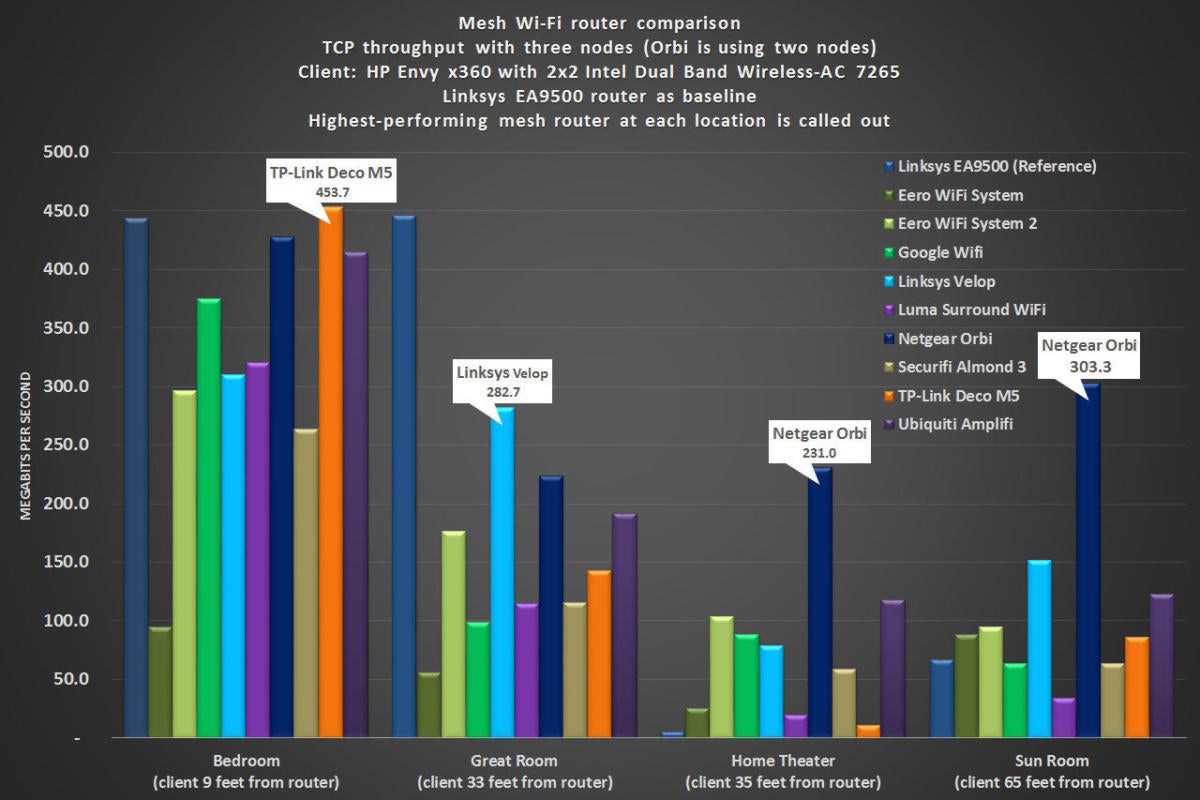
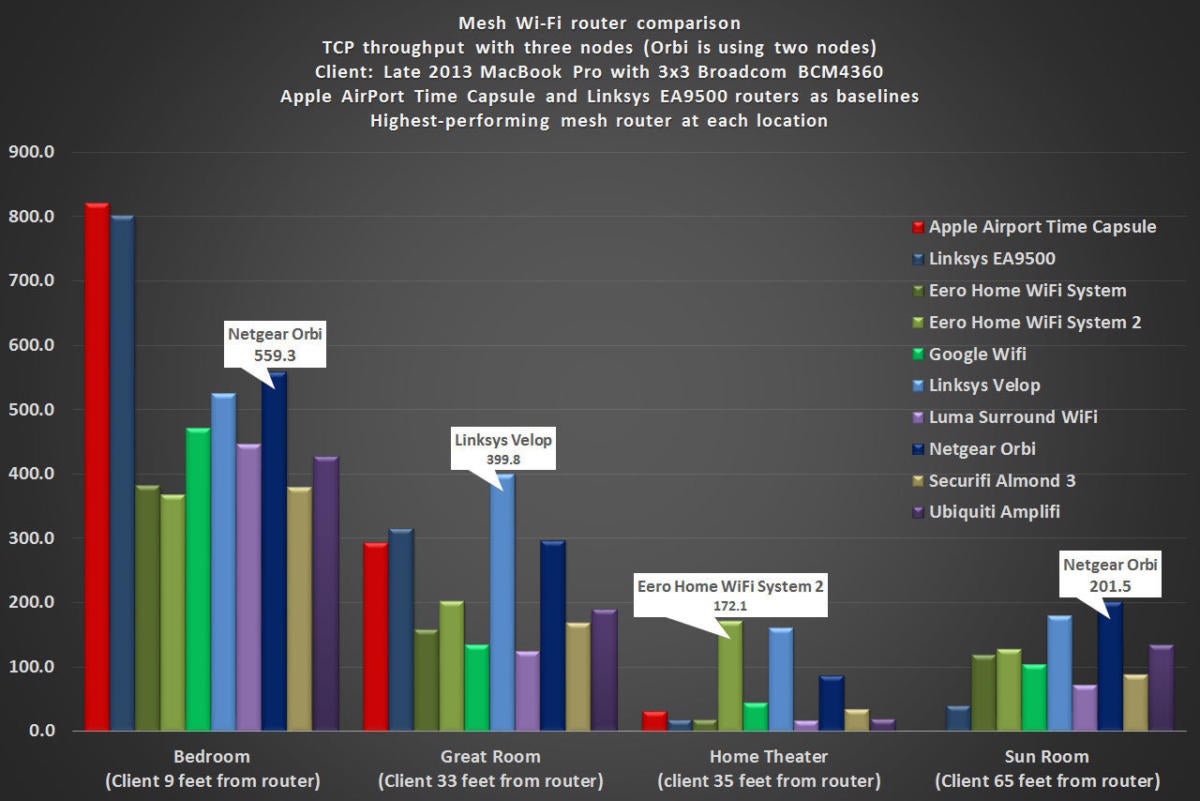
But when you take the benchmark charts infra, you'll see that while the new Eero (I'll call it Eero 2 from here) is much faster than the first-coevals merchandise, it was the fastest mesh router in the field of eight that I've tested up to now in only one location in my abode, and that was with a MacBook Pro As the customer. Interestingly, that location was my home theater, a spot that most wireless devices induce difficulty penetrating because of the thickness of its walls and ceiling and the presence of acoustical caulk sandwiched between its ninefold layers of drywall.
When the node was an Horsepower Envy running Windows 10, the Eero 2 took second place in the home theater. Most everywhere other, the Eero 2 finished in the mid of the pack. The Eero 2 was faster than the original product in all location—with both a Windows and a Mackintosh laptop client—except one: the bedroom, where the clients are in the same elbow room as the router and separated by nine feet of air.
 Michael Dark-brown/IDG
 The Eero 2's performance is described aside the light chromatic-greenness bar. Netgear's router-summation-orbiter Orbi wasn't always the fastest, simply it was always much faster than the Eero 2.
Path lighting? In an entree point?
Eero's Beacon—which, incidentally, is backward-harmonious with the first-generation Eero router—isn't a new conception. We first saw information technology with Ubiquiti Labs' Amplifi HD, and Netgear has a new Orbi model with a add-i satellite, too (I have matchless in my reexamine queue now). Eero's is by further the smallest and the most attractive, and it has a unique and same thoughtful feature: an integrated LED nightlight.
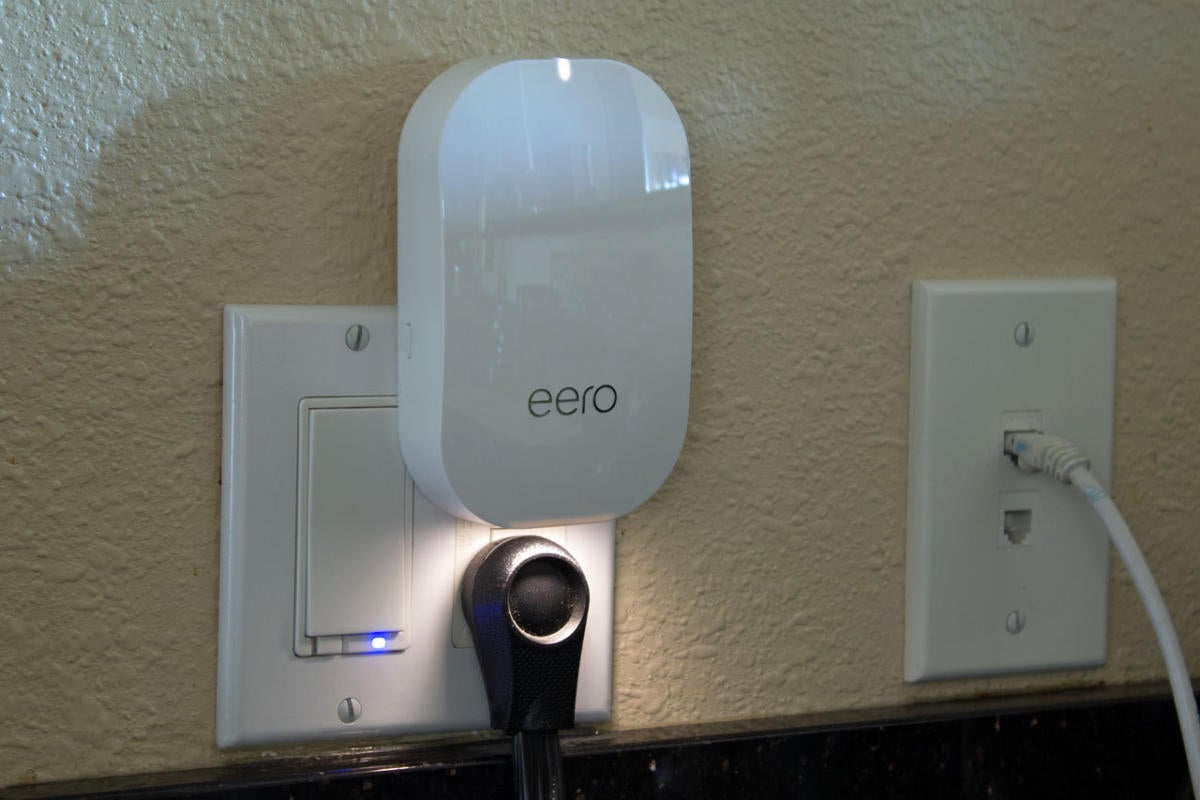
An ambient light sensor on the Beacon will mechanically turn the nightlight on when IT's dark, and the light's intensity will scale with the room's lighter. You can use the Eero app to program it to turn off and inactive at designated times. You put up telephone dial the time in precisely enough, but the schedule will be the same for regular of the workweek, thither's no more adjustment for daylight savings time, and you can't set IT to show up at dusk and dispatch at dawn. It's a chilly and thoughtful feature, and IT leave advance you to billet the Beacons out in the unsettled where they'll be the most impelling. The nightlight isn't as pearlescent as the unrivaled on the latest SnapPower Guidelight outlet cover, simply information technology provides good-enough route lighting. If you find the light trespassing, you can turn it off in the app.
 Michael Brown/IDG
 The Beacon has an integrated nightlight that adjusts its light according to ambient light conditions.
Draw radio aboard
The Eero router and the Beacon light have other differentiating feature: a String radio. Thread is an enterprising wireless mesh net designed to connect devices such as thermostats, appliances, lighting, and hurt introduction locks in the dwelling house. In this honour, it's similar to the Z-Wave and ZigBee mesh topology-network technologies that preceded it.
Originally formed by Cuddle Labs—which uses it in its thermostats, smoke detectors, and other products—Thread is also backed by several different leaden-hitters, including Qualcomm (witness above), Haiku (ceiling fans and lights), Elihu Yale (entry locks), Schneider Galvanic (ignition controls), and Somfy (motorized blinds, among other things). Thread has dozens of impulse behind it, but it hasn't yet had its daylight in the sun. In other words, Don River't bargain an Eero 2 because it has Thread radios aboard. There's very little practical value in that feature today.
 Michael Brownish/IDG
 The Eero 2 scored a surprise succeed in my home theatre when I benchmarked it with a MacBook Pro.
Initiation (and the app)
I'm covering this present because I wanted to undergo the performance numbers out of the way best. If you're superficial for the quickest router on the market, you've credibly obstructed reading past now. None of the meshwork routers I've tested have been difficult to set up, and the Eero 2 is certainly no exception. Each step is spelled out clearly with comfortable-to-sympathize text and illustrations. The app even presents floorplans for contrastive styles of abode and lets you fix the turn of floors your nursing home has. Based on your choices, it will advocate optimal placement for the router and the Beacons. Apiece time you place a Beacon, the app will perform a network test to determine how optimal that locating is.
It took all of 15 minutes to start out my meshing up and running, including providing custom names for all access aim. You'll need an Android or iOS device for setup, however, because in that respect is no web browser interface. The app has a great surety feature, overly. Once you've set up your network, you must log into the app by providing your telephone set number. Eero then sends you a textual matter message with a substantiation code that you type into the app to gain access.
 Michael Brown/IDG
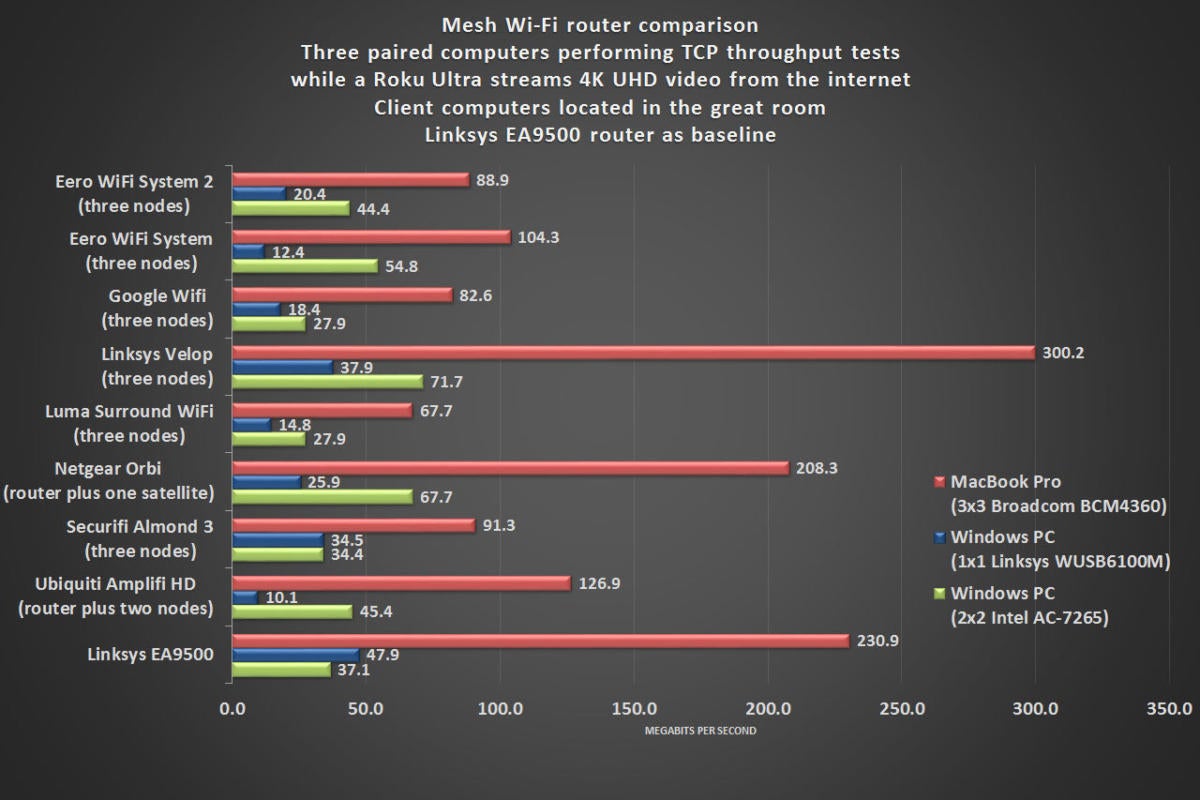
 This benchmark graph shows TCP throughput between three pairs of computers while a Roku Ultra streams 4K UHD telecasting from the web to a television.
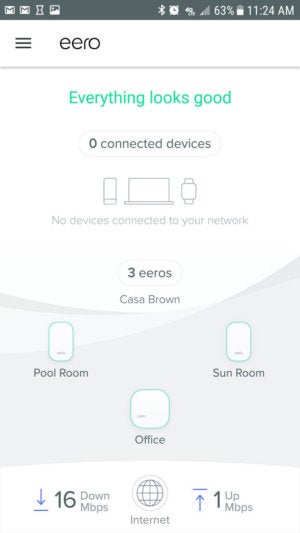
Once your mesh is pose up, the app's splasher reports on the health of your network at the top, and the speed of your internet link at the backside. In the intervening, the app informs you of how many a clients are connected to the network. Below that, it displays the name of your network and how many an Eero devices it consists of. Tap one of the icons representing the client devices on your network, and the app displays details such as how that device is attached (wired or wireless, and if wireless, which waveband IT's using and the strength of its connection); which Eero gimmick information technology's connected to (an Eero beacon operating theatre the Eero router itself); the customer's IP and MAC addresses; and more. A big crimson clit at the bottom of the screen lets you block the client from your network—serviceable if you discover an unauthorized user.
You can operate one guest network, for which a passphrase has already been official. You fanny redact the passphrase or just push a push in the app to generate a new one. They're easy enough to remember—one generated password was PapersAirplanes833—but they'ray even easier to share. Just pushing the Share Edgar Guest Network button to copy it to your device's clipboard. From in that location, you can paste it into a text message. The guest network allows visitors to get along the internet, merely they commode't access network files operating room stream media to devices happening the net. If you deprivation to Grant a sure visitant Sir Thomas More privileges, you can copy and paste the firsthand network's passphrase in the same fashion. Just be aware that they'll have full access to anything on your network that's not protected with a login process of its own.
 Michael Brown
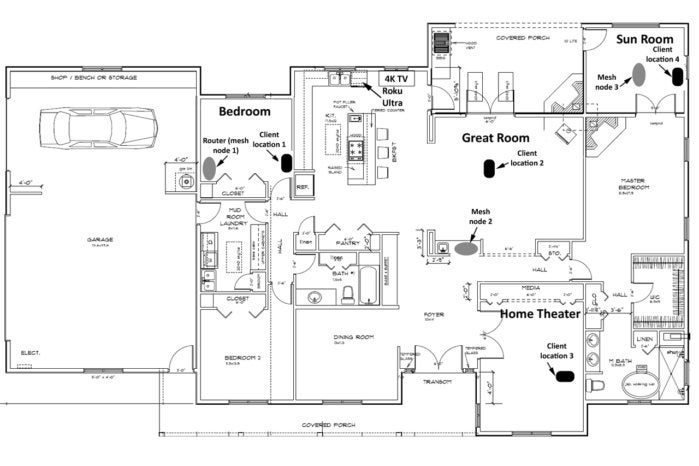
 This floorplan shows where the router, mesh nodes, and clients were placed for benchmarking.
Parental controls
For each one node device hindquarters be assigned a nickname and assigned to a user profile. User profiles tie into Eero's maternal control system, which suffers from all the same problems every otherwise parental control system does. That's because to each one device rear atomic number 4 assigned to only same user profile. So if you assign the all-in-one Microcomputer in the kitchen to your fry's profile, any restrictions you position on that profile will apply to anyone using that computer—including you. Sure, you can whip out your phone and temporarily transfer that computer to your unrestricted profile, but that's a hassle. And what are the chances that you'll forget to switch it back over again when you're finished?
 Michael Brown/IDG
 The Eero dashboard presents all the just about monumental information you need in one screen door.
Eero also offers a subscription service that bundles in advance parental controls. Peerless feature, for exemplify, forces child profiles to use Google or Bing SafeSearch, so search results don't expose them to adult cognitive content. Your $10 monthly subscription ($99 per year) also includes whole-network anti-virus and anti-malware protection. Dubbed Eero Asset, the table service entitles you to priority tech support, too ("limited or no wait time," Eero says).
Ripe router features
Unlike many of the "user-friendly" routers on the market, Eero doesn't hide advanced router features from you. You can't twist every knob and dial in the Eero 2, but you can do things such as reserve IP addresses and determined up port forwarding, to prepar it easier to access meshwork devices from the internet; choose a custom DNS provider; and operate the router in "bridge" mode, so you can run it slow some other router if you choose.
Is it worthy?
The sec-generation Eero Home WiFi System is attractively premeditated, casual to fix and use, and very capable. Router geeks won't represent impressed with how close to the metallic-looking they privy get, simply Eero exposes enough of its inner workings to satisfy just virtually anyone else. I was a little related roughly the Beacons' being then close to the floor, but the antenna positioning seems to take over taken care of that. And in my test environment, the Beacon in the center of my plate was at counter height (because I have a wet bar in the center of my home).
The Eero 2's $399 list price, yet, is steep—especially when you throne pick aweigh the original, overmuch faster Netgear Orbi Home WiF scheme for $50 less. Yes, that buys you a router and only same satellite, merely the Orbi was nonetheless significantly faster at almost every location in my home. On top of that, Netgear plans to release a firmware update in the late August/archaic September time frame that will enable hardwired backhaul along the Orbi satellite. If you have the family infrastructure to take over advantage of it, it will significantly increase your network speed.
To get that feature from Eero, you'll need to come ou to the Eero In favou WiFi organization. You'll get triad Eero 2 nodes, but it's even Thomas More expensive at $499. Alternatively, you derriere buy a concentrated Eero for $199 and configure information technology as an memory access point. Bingle Beacons, meanwhile, cost $149 apiece. I'm not currently using a mesh electronic network in my family, because I have radio receiver access points with hardwired backhaul. If I were to switch today, it would be to an Orbi system.
Correction: This review earlier reported that the Netgear Orbi already supported hardwired backhaul from its satellites. The chipset does, but the microcode South Korean won't be useable until the August/September time frame.
Note: When you purchase something after clicking links in our articles, we may earn a puny deputation. Read our affiliate link insurance policy for to a greater extent details.
Michael is TechHive's lead editor program and covers the wise home and home entertainment markets. Helium well-stacked his own voguish habitation in 2007, which he uses as a real-world test lab when reviewing new products. Michael also reviews routers and networking products for TechHive and PCWorld.

Source: https://www.pcworld.com/article/407070/eero-home-wifi-system-2-review-beacons-make-this-system-even-easier-to-install.html
Posted by: burnspeave1960.blogspot.com
0 Response to "Eero Home WiFi System 2 review: Super easy to install, but expensive - burnspeave1960"
Post a Comment